April 19–20, 2027
Schedule
Two days of celebration in Kyoto — a welcome gathering the day before, and the wedding day itself.
The ceremony and reception are the heart of it all, and we hope everyone can join us for that. We'll also be hosting a welcome gathering before the wedding day for those whose schedules allow — please feel free to attend whatever works for you.
Important We need accurate headcounts for each venue, so please RSVP separately for the welcome gathering and for the ceremony/reception. Please only RSVP if you'll be in Kyoto and able to join that specific day.
Monday, April 19, 2027
Welcome Gathering
Optional EventA relaxed get-together to kick off the celebration and catch up before the big day. We're still finalizing the details. If you can join us, wonderful. If not, we'll see you at the ceremony!
Time
Time to be announced
Location
To be announced
Map coming soon
Dress Code
To be announced
Please RSVP only if you plan to attend — this helps us finalize our reservation.
Tuesday, April 20, 2027
Wedding Day
The ceremony begins at 4:30 PM, followed by cocktail hour, dinner, and dancing.
4:30 – 5:00 PM
Ceremony
5:00 – 6:20 PM
Cocktail Hour & Photos
Drinks and finger foods while we take photos with the wedding party and families.
6:30 – 9:45 PM
Reception & Dinner
Dinner, dancing, and celebrating with family and friends.
The Venue
THE HIGASHIYAMA CLUB by HAPPO-EN
Formerly known as 京都祝言 (Kyoto Shugen) — you may still see this name on Google Maps or hear it from taxi drivers. It's the same place.
385-8 Yasakakamicho, Higashiyama-ku, Kyoto 605-0827, Japan
Show this to your taxi driver
THE HIGASHIYAMA CLUB by HAPPO-EN(旧:京都祝言)
〒605-0827 京都府京都市東山区八坂上町385-8
Phone
By Train
The nearest station depends on the line: Hankyu Kawaramachi Station — 20-minute walk. Keihan Gion-Shijo Station — 15-minute walk. JR Kyoto Station — 15 minutes by car/taxi.
By Taxi
About 15 minutes from JR Kyoto Station. Taxis cannot pick up or drop off directly in front of the venue — please ask your driver to use 高台寺南門通り (Kodaiji Nanmon-dori). From there, it's a short walk up a stone-paved path to the building.
Parking
There is no dedicated parking at the venue, and nearby coin parking lots can be crowded. Train or taxi is the easiest way to arrive.
A note on the walk up
The path from the street up to the venue is stone-paved and slightly uphill. If you'll be in heels — or just prefer to walk comfortably — feel free to bring a pair of flats or sneakers for the walk up. You can swap into your nicer shoes once you arrive.
Dress Code
Formal
Floor-length dresses, suits and ties.
Not your typical spring palette — a dark and moody April evening in Kyoto. Here's a feel for the mood. We'd love for you to lean into it: deep, rich tones over bright ones. Take the palette as inspiration rather than a rule — most of all, wear what makes you feel wonderful.
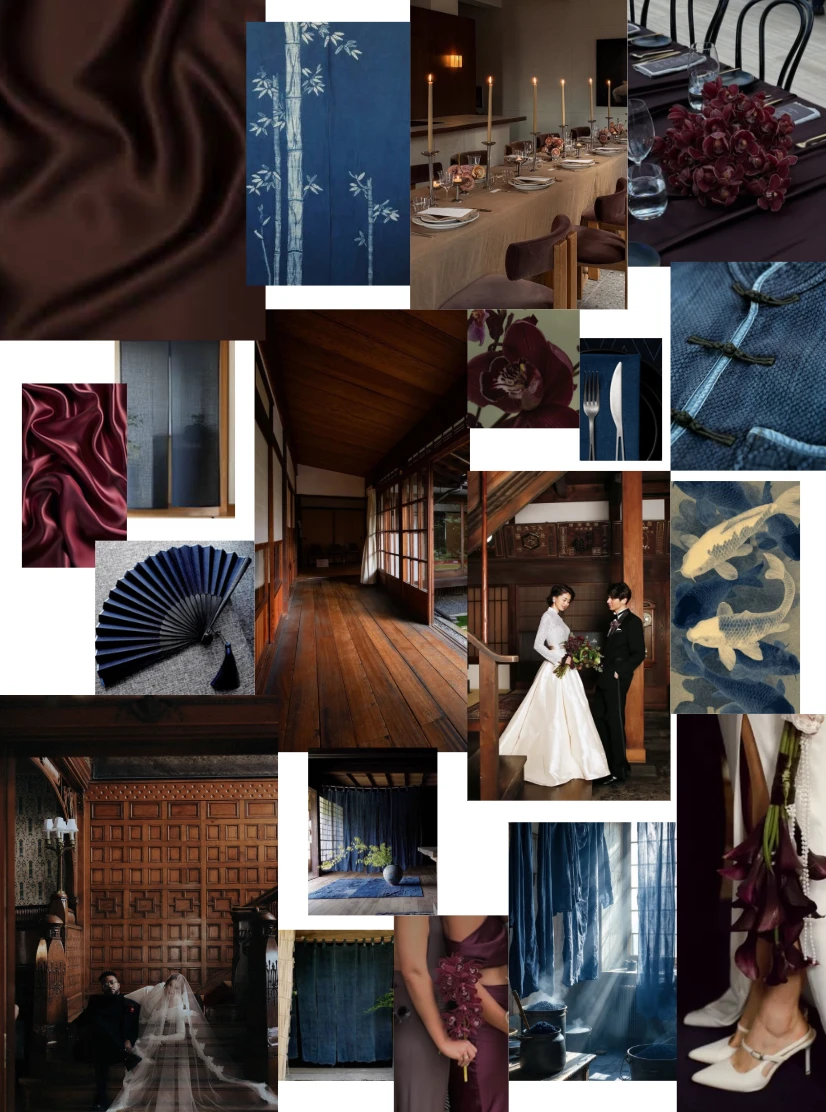
Our Palette
-
Dark Chocolate 焦茶 Kogecha “Scorched tea” — one of the many browns of old Japanese architecture. + The story – The story
Its name means something close to “scorched tea.” In the Edo period, ordinary people were largely limited to brown, grey and indigo, so browns multiplied into countless shades — the dark, warm wood you still see throughout old wooden houses.
-
Deep Indigo 留紺 Tomekon Indigo at its deepest, from dipping the cloth again and again. + The story – The story
Indigo deepens each time the cloth goes back into the vat, and tomekon sits near the darkest end of that range — the “stopping” shade, about as deep as it goes. Japan grew and fermented its own indigo for centuries, and a British chemist newly arrived in the 1870s, struck by how much of it he saw everywhere, called the colour “Japan Blue.” It's the same tradition behind Japanese denim — those regions were working with indigo long before anyone there made jeans.
-
Wine 蘇芳 Suō One of Japan's oldest dye reds, long a colour of the court. + The story – The story
It comes from sappanwood — a tree whose heartwood yields a rich red dye. Prized since antiquity, it carried a quiet sense of rank and refinement.
-
The venue's own.
Honey-Caramel 聚楽 Juraku A traditional Kyoto clay — the warm base tone of the venue, alongside its dark wood. + The story – The story
This one belongs to the venue rather than to us. The name traces back to Jurakudai, a palace Toyotomi Hideyoshi built in Kyoto in the 1580s — the fine clay from that district became a prized plaster for traditional earthen walls, the warm, quiet finish you still find in tea rooms and old townhouses. Together with the dark wood, it's the base tone of the rooms we'll be in.
We can't wait to celebrate with you in Kyoto.